Multi-robot rendezvous in communication-restricted unknown environments via backtracking and semantic frontier-based exploration
roboticsFBE-BT (our)
FBE 3X
Abstract
The multi-robot rendezvous problem requires coordinating a team of mobile robots to converge at a common location. Efficient decentralized execution with limited communication and in unknown environments can be essential in several applications, but such real-world robotic features are often not captured by theoretical rendezvous frameworks. In this work, we present an approach to this problem that extends traditional frontier-based exploration strategies to facilitate efficient rendezvous in such conditions. Our method allows robots to backtrack their exploration of the environment and exploit semantic knowledge on the map by prioritizing high-connectivity areas like corridors and hallways. We define and evaluate different variants of our method to study a trade-off between the time taken to perform a rendezvous and the amount of discovered area in the environment. Extensive experimental evaluation in ROS using 3D simulations demonstrates the feasibility of our method and its performance improvements over baselines.
Scenario
We consider the rendezvous problem for a team of autonomous mobile robots in the challenging setting of a communication-restricted and initially unknown indoor environment. The robots start from different arbitrary locations, but no map of the environment is available to any of them and no pre-determined meeting location or coordination strategy has been agreed upon. Communication is restricted to occur only after a rendezvous.


The difficulty of the rendezvous problem is augmented by the fact that the team needs to simultaneously perform an online exploration task, as the environment is unknown. The widely used frontier-based exploration strategy is in contrast with what is required by an efficient rendezvous, which, in principle, does not strictly require building a complete map.
Exploration
Rendezvous
Method
We propose an extension of the classical Frontier-Based Exploration (FBE) biased towards Rendezvous (hence the acronym FBR). Frontiers are created not only for their potential contribution to the map’s expansion but also to increase the opportunity of meeting a teammate. To do so, we introduce an exploration trace with an information decay mechanism that allows each robot to forget about parts of the environment that have been explored, creating hallucinated frontiers. The robot is thus encouraged to backtrack on previously explored areas, facilitating accidental rendezvous. When robots meet, they form a cluster, merging their exploration traces and sharing frontiers. The rendezvous is completed when all robots are inside the same cluster.
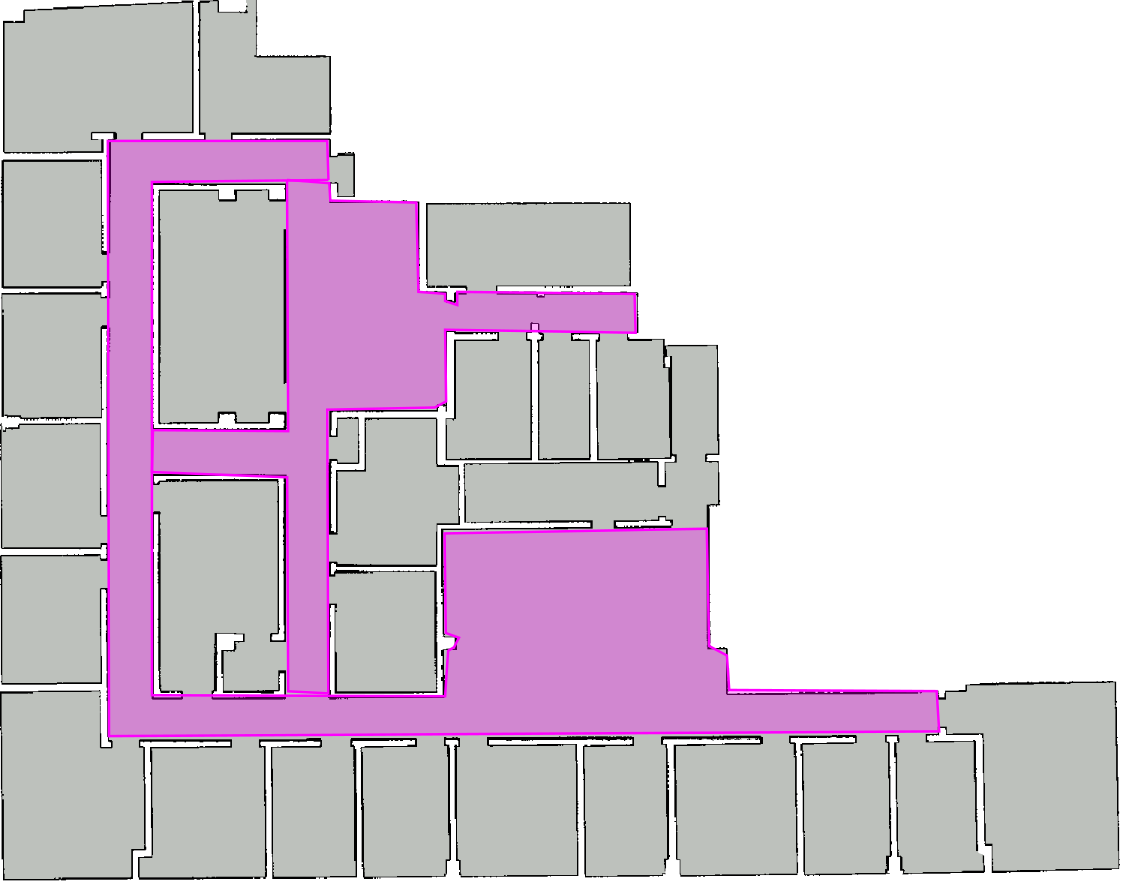
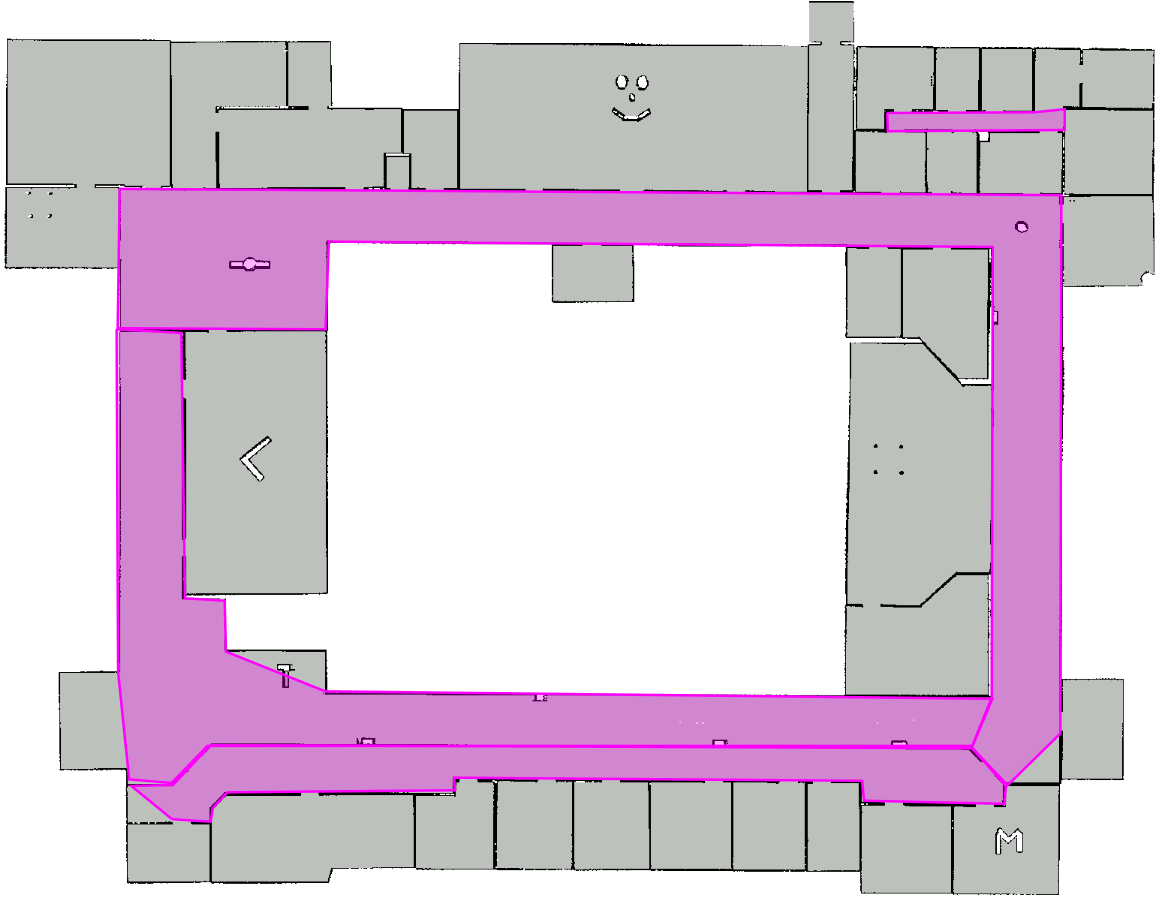
To further increase the chance to complete a rendezvous, we assume the robot is able to distinguish high-connectivity areas (such as hallways or corridors) from peripheral ones (like small rooms or offices), and we propose an extension of the standard utility function in which frontiers in high-connectivity areas have increased importance.
Experiments
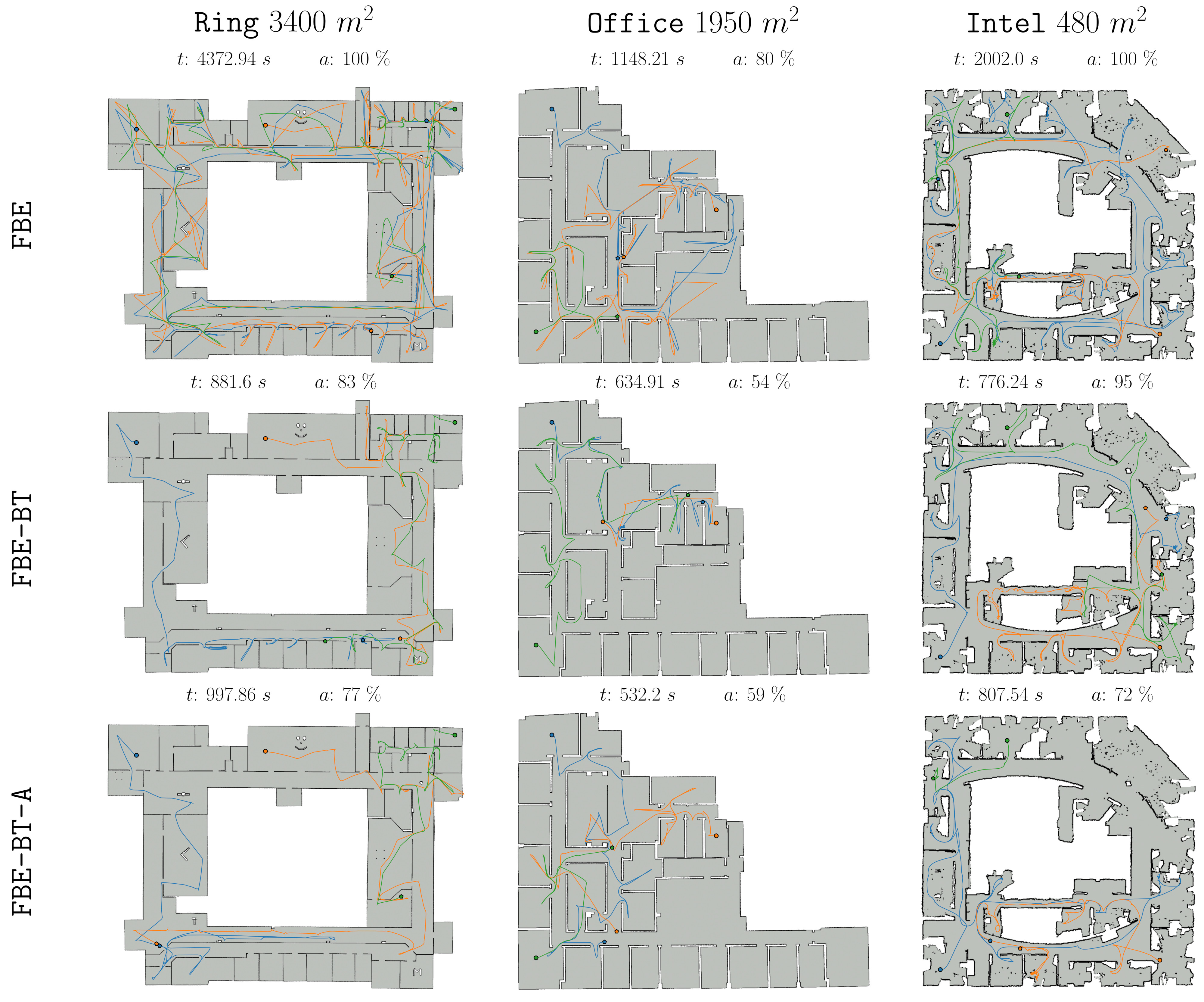
We validate our approach with an extensive experimental campaign in realistic simulations, performing real-time runs with a Turtlebot-3 burger exploring large environments simulated with Gazebo. The results demonstrate that our method encourages the robots to backtrack on previously-visited locations, facilitating accidental rendezvous. Adding the backtracking to the standard frontier-based exploration increases the rendezvous by approx. 40%, an improvement that is further enhanced by considering the high-connectivity areas while choosing the next location.
FBE-BT (our)
FBE 2X
BibTeX
@article{LUPERTO2025105137,
    title = {Multi-robot rendezvous in communication-restricted unknown environments via backtracking and semantic frontier-based exploration},
    journal = {Robotics and Autonomous Systems},
    pages = {105137}, year = {2025}, issn = {0921-8890},
    doi = {https://doi.org/10.1016/j.robot.2025.105137},
    author = {Matteo Luperto and Mauro Tellaroli and Michele Antonazzi and Nicola Basilico}
}
@INPROCEEDINGS{10801321,
    author={Tellaroli, Mauro and Luperto, Matteo and Antonazzi, Michele and Basilico, Nicola},
    booktitle={2024 IEEE/RSJ International Conference on Intelligent Robots and Systems (IROS)},
    title={Frontier-Based Exploration for Multi-Robot Rendezvous in Communication-Restricted Unknown Environments},
    year={2024}, pages={5807-5812}, doi={10.1109/IROS58592.2024.10801321}
}